
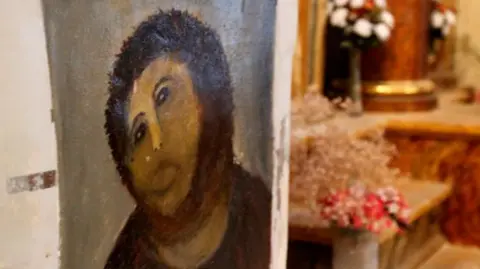
The Spanish parishioner who made international headlines for her infamous restoration attempt on a valuable Jesus Christ fresco has died at the age of 94.
Cecilia Giménez, from the town of Borja in northern Spain, became a global sensation 13 years ago after she undertook to restore a 100-year-old painting known as Ecce Homo located in her local church.
Giménez's restoration effort quickly went viral and earned the moniker "Potato Jesus", because the resulting likeness of Christ's head bearing a resemblance to a hairy monkey.
Local Confirmation and Tribute
The 94-year-old's death was confirmed by the town's mayor, Eduardo Arilla, in a social media post, where he acknowledged her as a "passionate lover of painting from a young age".
"Rest in peace Cecilia, we will always remember you," Arilla wrote.
Arilla also paid tribute to Giménez's "famous restoration of Ecce Homo" in the summer of 2012, which "because of the deteriorated condition it presented, Cecilia, acting in good faith, chose to apply new paint over the original".
The Artwork's History and the Now-Infamous Act
The Ecce Homo ("Behold the Man" in Latin) by nineteenth-century artist Elias Garcia Martinez had resided for over a hundred years in the Sanctuary of Mercy Church near Zaragoza.
In 2012, Giménez, then 81, explained that church members had "always repaired everything here", and that she had received permission from the parish priest to proceed.
She added at the time that anyone who came into the church would have seen she was applying paint to the original artwork.
An Unexpected Tourist Boom
The aftermath of the repaint job spawned the "Ecce Mono" internet phenomenon and transformed the once quiet town of Borja quickly become a significant visitor attraction.
The town, which had previously seen only 5,000 tourists per year, attracted more than 40,000 tourists by 2013, and generated more than €50,000 for charity from the attention.
Currently, local authorities say that somewhere around 15,000 and 20,000 tourists visit Borja each year to view the notorious portrait, which is now displayed behind a pane of glass.
Legacy and Local Support
After recovering from the initial backlash, backed by local residents and well-wishers globally, Giménez went on to hold an art exhibition showcasing twenty-eight of her own works.
She was commended by Borja's mayor for her generosity and years of faithful service to the parish.
In the end, what began as a sincere but unsuccessful art repair created an unlikely piece of pop culture and brought remarkable attention and resources to a humble Spanish town.


